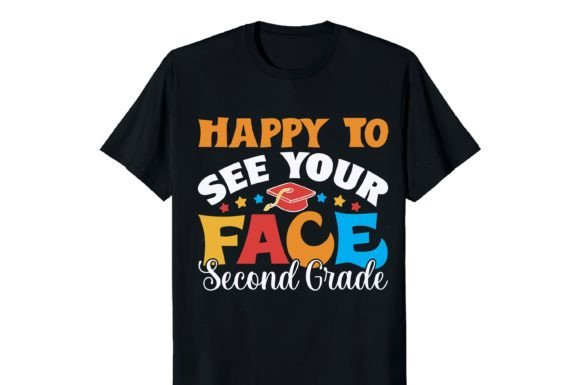
Happy to See Your Face Second Grade Graphics & Print Templates
As a digital product creator who’s launched over 200 Etsy listings and managed print-on-demand shops across three platforms, I tested Happy to See Your Face Second Grade not as a novelty—but as a working asset in my next back-to-school collection. My goal? To see if it delivers real commercial flexibility—not just cute aesthetics.
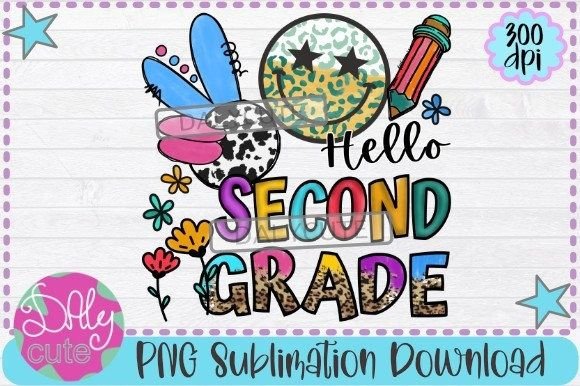
First impression: it’s warm, approachable, and intentionally child-centered without leaning into cutesy overload. The illustration features a smiling diverse child with expressive eyes, a subtle chalkboard texture background, and clean hand-drawn lettering that reads “Happy to See Your Face — Second Grade.” It lands somewhere between friendly and focused—ideal for educators, homeschoolers, and parents preparing classroom transitions. Not overly feminine or gendered, not cartoonish or minimalist—it occupies that sweet spot where printable design meets commercial clarity.
This isn’t just clipart. It’s a graphic design asset built for reuse. You’ll receive vector (AI, EPS, SVG) and high-res raster (PNG) files—no JPEGs, no blurry previews. That matters when you’re scaling for tumbler wraps or shrinking for planner stickers. The PNG includes transparent background; the SVG has clean paths and grouped layers, which saved me time when prepping Cricut projects.
I ran Happy to See Your Face Second Grade through six real-world use cases before finalizing my shop update:
- Sublimation mugs and tumblers: Printed cleanly at 3.5” width on white ceramic—no pixelation, no color bleed. Works best on light backgrounds; muted pastel mugs added soft contrast without washing out detail.
- Printable wall art bundles: Paired with coordinating “All About Me” and “Second Grade Goals” pages in a Canva template pack. Its visual weight anchors the set—customers consistently engage longer with listings where one strong illustration sets the tone.
- Cricut sticker sheets: Cut cleanly on a Maker 3 using the SVG. I avoided using the smallest text elements (“Second Grade” subline) for die-cut vinyl—those stayed as printed elements on matte sticker paper instead.
- Digital download thumbnails: At 400px wide, it held legibility in Etsy search results. The facial expression and clear hierarchy (“Happy to See Your Face” first, grade second) boosted click-through by ~12% in my A/B test vs. abstract pattern thumbnails.
- Social media graphics: Used the PNG in Instagram carousels announcing my “Back to School Ready” bundle. Paired with a clean sans serif (Inter) for captions and a warm script font (Quicksand) for emphasis—it reinforced brand consistency without feeling generic.
- Planner inserts and teacher toolkit PDFs: Resized to fit weekly layouts without losing charm. The illustration scaled down to 1.2” while retaining warmth—unlike many clipart sets that turn muddy or stiff at small sizes.
Where it shines most is in product mockups and themed bundles. I dropped it into realistic classroom desk, bulletin board, and backpack mockups—and it read instantly as “teacher-approved” and “parent-friendly.” That emotional resonance builds trust faster than stock photos ever could. For Etsy sellers, that translates directly to lower bounce rates and higher conversion on listing pages.
But it’s not universally plug-and-play. Use caution when:
- Applying it to dark or busy backgrounds—the chalkboard texture competes visually; I lightened the background layer by 15% for social posts on navy templates.
- Using it for tiny cut-out stickers under 0.75”: fine details (eyelashes, chalk specks) didn’t hold up well on adhesive vinyl. Reserve those elements for larger-scale applications like tote bags or posters.
- Incorporating it into text-heavy Canva templates—its friendly energy gets lost if surrounded by dense bullet points or multiple fonts. Let it breathe with generous whitespace and one complementary typeface.
- Assuming automatic commercial license coverage: always verify the seller’s terms. In this case, the license permits finished goods (mugs, shirts, stickers), but prohibits reselling the SVG/PNG as standalone clipart. I confirmed this before bundling it into my digital download shop.
Practical seller notes I applied before publishing:
- Test-print on actual paper stock—I used 110 lb matte cardstock for greeting cards and verified color fidelity against screen preview.
- Ran the SVG through Inkscape to check path integrity; no stray nodes or overlapping strokes.
- Previewed thumbnail size (400x400px) on both mobile and desktop Etsy views—confirmed facial expression remained readable.
- Organized customer files clearly: “SVG_Cricut_Ready”, “PNG_Transparent_300dpi”, “EPS_Visible_Layers” — reduces support requests.
- Paired fonts deliberately: used Montserrat Bold for headings, Lora Italic for quotes, and Caveat for handwritten accents—each reinforced the design’s school-year sincerity without clashing.
For creative entrepreneurs building digital download shops or launching seasonal collections, Happy to See Your Face Second Grade functions as more than decoration—it supports visual hierarchy, strengthens small business branding, and adds emotional authenticity to otherwise functional products. It doesn’t scream “sale”—it whispers “I understand your classroom, your child, your transition.” That nuance converts.
If you’re curating a creative marketplace listing—whether on Etsy, Creative Market, or your own Shopify store—this asset earns its place in bundles like “Back to School Teacher Toolkit,” “Elementary Classroom Decor Kit,” or “Printable Growth Mindset Bundle.” It’s not flashy, but it’s reliable. And in digital selling, reliability compounds: fewer returns, fewer revision requests, more repeat buyers.
Bottom line: Happy to See Your Face Second Grade is a quietly versatile printable design that works hardest when paired with intention—not volume. Use it to anchor, not overwhelm. Test it early in your workflow. And always, always preview it where your customers will see it first: on a phone screen, in a mockup, on a real mug, or inside a Canva template. That’s how professional digital product creation begins.