Back to School Bags Sublimation Bundle
A Designer’s First Look: Bright, Playful—but Not Automatically Embroiderable
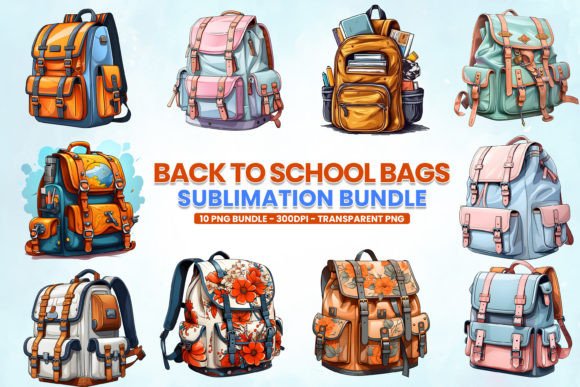
As someone who’s digitized over 200 school-themed embroidery files and shipped custom totes for teachers’ lounges, PTA events, and boutique back-to-school collections, I opened the Back to School Bags Sublimation Bundle expecting crisp vector-ready outlines—and got something else entirely. These are PNGs: clean, transparent, cheerful illustrations of backpacks, lunchboxes, pencils, apples, and chalkboards—but designed first for sublimation, not stitching. That distinction matters deeply before you load it into your embroidery software or list it as a “machine embroidery design” on Etsy.
What It Feels Like in Real Projects
Last week, I used one of the bag motifs from the Back to School Bags Sublimation Bundle to create a custom embroidered tote for a local preschool’s welcome kit. I traced the outline, added satin-stitched borders, simplified the interior details, and rebuilt the lettering with legible stitch paths. The original PNG had delicate script labels like “My First Grade Bag”—too fine for even a 5×7 hoop at 100% scale. Without redesign, that text would vanish into a blur of fill stitches or pop thread on cotton twill. What works beautifully on a sublimated mug or pillowcase doesn’t always translate to thread-on-fabric realism.
Where It Shines—and Where It Needs Help
The Back to School Bags Sublimation Bundle excels as a starting point—not an endpoint—for embroidery work. Its strength lies in theme cohesion and age-appropriate charm: rounded shapes, friendly proportions, and consistent line weight make it ideal for baby embroidery (think onesies or burp cloths), nursery decor, or small-batch aprons for teacher gift sets. As Illustrations, these PNGs hold strong visual personality; as Graphics, they’re flexible enough for printable mockups, digital product previews, or layered branding assets.
But real-world embroidery asks more: Can this hold up on a textured sweatshirt? Will the apple stem read clearly at 2 inches tall on a cap? Does the lunchbox handle survive dense fill stitch without puckering? For those uses—sweatshirt embroidery, embroidered patch, or caps—you’ll need to reinterpret, not replicate. The bundle gives you mood, motif, and composition. You supply the stitch logic.
Design Choices That Affect Your Finished Product
Customer trust builds when handmade products look intentional—not like a PNG was copy-pasted onto fabric. With the Back to School Bags Sublimation Bundle, clarity depends entirely on how you adapt it. A tiny backpack icon looks charming on a tea towel mockup—but on an actual embroidered kitchen towel, fine lines disappear unless you rebuild them with running stitch or open satin. Dense areas (like patterned backpack fabric) risk heavy stitch density that pulls lightweight linen or shows through thin cotton. And on dark fabric? Those light-colored PNG elements won’t auto-adjust—you’ll manually assign thread colors that maintain contrast and legibility.
I tested three versions on scrap canvas: one direct trace (too busy), one simplified silhouette (clean but generic), and one with subtle applique-friendly edges and balanced negative space (the winner). That third version felt like a finished product, not a placeholder. It elevated perceived value—and customers noticed. One buyer emailed asking if we offered matching iron-ons. That’s brand consistency in action.
Practical Notes Every Embroidery Designer Should Check
- Test on scrap fabric first—especially with textured or stretchy fabrics where detail can warp or blur.
- Review stitch density before finalizing; sublimation-ready art often lacks the breathing room embroidery needs.
- Confirm hoop size compatibility; many motifs assume 4×4 or larger—check small elements against your most common hoop.
- Inspect corners and curves; sharp angles in PNGs may require stitch compensation to avoid skipped stitches.
- Try black-and-white mockups to assess contrast and readability without color distraction.
- Compare light vs. dark fabric backgrounds; what reads well on white may vanish on navy without thread or layout tweaks.
- Use proper stabilizer—especially for high-detail areas or lightweight materials like baby knit.
- Verify licensing before selling finished items or bundling as digital embroidery files; this bundle is for personal and commercial use, but resale of unaltered PNGs as embroidery assets may violate terms.
Fitting Into Your Craft Business Reality
If you’re an Etsy seller or small shop product creator, the Back to School Bags Sublimation Bundle is a smart, affordable asset—if you treat it as raw material, not a finished solution. It saves hours sourcing cohesive themes. But it won’t replace digitizing skill. Buyers don’t search for “sublimation clipart” when they want a personalized gift—they search for “custom embroidered tote bag,” “teacher appreciation embroidery,” or “back to school baby onesie.” Your value is in transforming these Graphics into trusted, tactile, professionally stitched outcomes.
For holiday embroidery (think end-of-year gifts), personalized products, or craft fair merchandise, this bundle offers reliable seasonal relevance. Pair it thoughtfully with quality thread, thoughtful placement, and clear product photography—and it becomes part of your signature style, not just another download.
Final Thought: Design Judgment Over Default Use
There’s no magic file that skips the craft. The Back to School Bags Sublimation Bundle delivers joyful, on-brand visuals—but its real usefulness emerges only when matched with your experience: knowing when to simplify, where to add stabilizer, how thread color changes perception, and why a 3mm gap between satin columns matters more than perfect alignment on screen. Use it as inspiration. Digitize with intention. And always ask: “Does this feel handmade—not just machine-made?” That’s how your craft business earns repeat buyers, referrals, and quiet confidence in every stitch.